George W. Bush's Foreign Policies: Principles and Pragmatism by Donette Murray & David Brown & Martin A. Smith
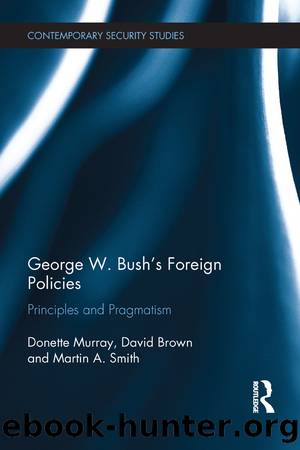
Author:Donette Murray & David Brown & Martin A. Smith [Murray, Donette & Brown, David & Smith, Martin A.]
Language: eng
Format: epub
Tags: International Relations, Diplomacy, Political Science, Security (National & International), General
ISBN: 9781317698043
Google: qVsyDwAAQBAJ
Goodreads: 35740639
Publisher: Routledge
Published: 2017-08-23T09:29:03+00:00
Conclusions
The first responsibility of any government is to keep its citizens safe from harm, both internal and international. Given the challenge confronting the Bush administration in its opening year, with an attack that killed over 3,000 people on a single day, dealt a severe blow to the economic health of the nation and shook faith in the credibility of the US government to maintain its social contract with its own people, it should be noted at the outset here that the administration did ultimately manage to keep the US safe from similar attacks for the remainder of Bushâs time in office. This was an achievement that most Bush officials would have doubted was possible in the panic-filled days after 9/11 and the ensuing anthrax incidents,69 when fevered imaginations conjured up a threat of almost apocalyptic proportions. Such context is important. While it is difficult to draw a direct cause and effect between Bushâs strategy and the absence of further successful terrorist attacks on US soil (as Donald Rumsfeld noted in a different context, absence of evidence is not necessarily evidence of absence),70 it would take the most committed partisan to deny his administration at least some credit for this achievement.
However, costs cannot solely be measured in these terms, nor can the manner in which the Bush administration took the fight to the terrorists be excused its wider impact, with a 2007 poll noting that 82 per cent of Americans felt the world was less safe and was getting worse, not better.71 While Washington remained relatively safe, Baghdad burned and Kabul quaked under a resurgent Islamist threat, primarily from a rejuvenated Taliban that the Bush administration had foolishly believed it had definitively broken up. One commentatorâs claim that âno terrorist organisation could have absorbed the punishment the US has inflicted on Al Qaeda ⦠and survivedâ72 has sadly proved not to be the case. Al-Qaeda may have ceased to have the same global impact as in the 1990s and early 2000s, although a 2007 NIE concluded that it had âprotected or regenerated key elements of its homeland attack capability, including a safe haven in the Federally Administered Tribal Areas [of Pakistan], operational lieutenants and its top leadershipâ.73 The shifting focus of the Bush administration away from Afghanistan and Pakistan and towards Iraq, however, ultimately aided it in regrouping, fuelled further by the flames of renewed radicalization generated by the inept occupation of the latter state. Additionally, Islamist terrorism generally has mutated, moved and adapted to the US-led counter-measures and thus ultimately survived.
It remains difficult to produce effective and agreed metrics for measuring success and failure in combating terrorism â not least because of the lack of an agreed baseline, in terms of both the nature of terrorism itself and the scale of the pre-existing problem, coupled with a failure to understand even now what radicalizes individuals sufficiently to cross the Rubicon from extremism to terrorism. Yet, one should not downplay the radicalizing impact of perceived aggressive US actions, whether the semi-public
Download
This site does not store any files on its server. We only index and link to content provided by other sites. Please contact the content providers to delete copyright contents if any and email us, we'll remove relevant links or contents immediately.
| Arms Control | Diplomacy |
| Security | Trades & Tariffs |
| Treaties | African |
| Asian | Australian & Oceanian |
| Canadian | Caribbean & Latin American |
| European | Middle Eastern |
| Russian & Former Soviet Union |
The Secret History by Donna Tartt(19088)
The Social Justice Warrior Handbook by Lisa De Pasquale(12190)
Thirteen Reasons Why by Jay Asher(8910)
This Is How You Lose Her by Junot Diaz(6887)
Weapons of Math Destruction by Cathy O'Neil(6280)
Zero to One by Peter Thiel(5802)
Beartown by Fredrik Backman(5754)
The Myth of the Strong Leader by Archie Brown(5507)
The Fire Next Time by James Baldwin(5445)
How Democracies Die by Steven Levitsky & Daniel Ziblatt(5218)
Promise Me, Dad by Joe Biden(5153)
Stone's Rules by Roger Stone(5088)
A Higher Loyalty: Truth, Lies, and Leadership by James Comey(4964)
100 Deadly Skills by Clint Emerson(4925)
Rise and Kill First by Ronen Bergman(4789)
Secrecy World by Jake Bernstein(4753)
The David Icke Guide to the Global Conspiracy (and how to end it) by David Icke(4719)
The Farm by Tom Rob Smith(4511)
The Doomsday Machine by Daniel Ellsberg(4490)
